
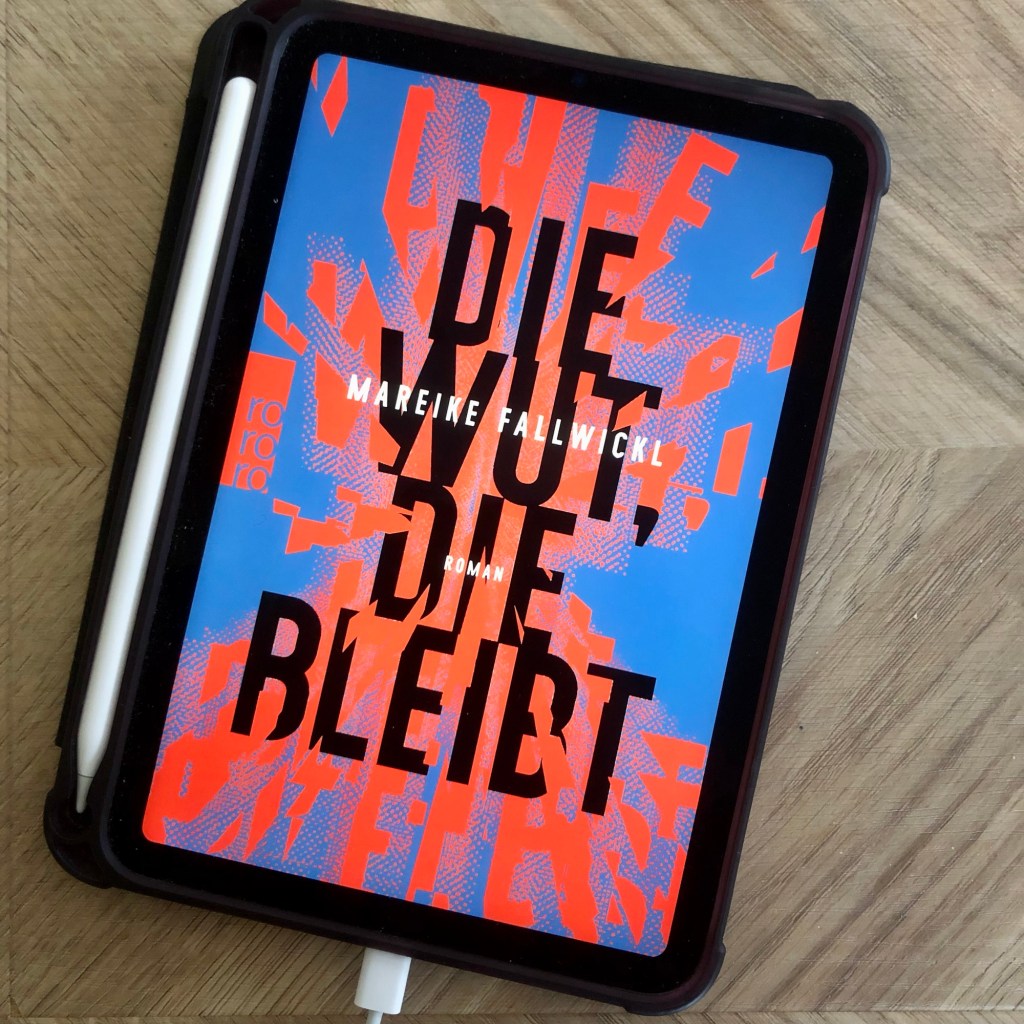
A man asks a woman to pass the salt, and she gets up, walks past him out onto the balcony and… jumps. Leaving behind her teenage daughter, two young sons and their father, and her best friend. Was it one lockdown too many, or simply the last straw added to a more-than-double burden of care that so many women bear?
In Die Wut, die bleibt (Rohwolt 2022), Mareike Fallwickl’s characters are raging for a reason. Lola, Johannes, Maxi and Lucius, and Sarah are all grieving the loss of Helene, a woman they loved. When three teenage boys assault Lola and her best friend Sunny in their beloved skate park, they decide to fight back. They do self-defence training, and meet other young women like them, who all have reasons to rage. And violent men to rage against.
Will the violence spiral out of control? Will the men even notice what the women are feeling, or the care work they are doing to hold everything together?
Fallwickl has set her third novel in her home town of Salzburg, and the adult women in the story are about her age. Her latest novel, Und alle so still (And all so quiet) was published in the middle of last month. It continues the theme of women who’ve had enough – of care work – and decide to revolt. As soon as I finished Die Wut, I got myself a copy of Und alle so still.
It’s a cracking read. I was drawn to Lola, the teenage girl who is so sure of her feminism and so ready to rage against the system, and tentatively turning to queer desire. I was drawn to Sarah and Helene, who are a couple of years younger than me, but whose experience is so different. They are in straight relationships and looking after children in a society that does not help. I would have liked things a little less binary and cis, but one book can’t do everything. One woman can’t do everything. And that is Fallwickl’s point.
If you’ve read The Power or Babel and wondered how realistic it was… If you’ve wondered where to draw the line between rage and restoration… If you’re very tired of hearing “not all men” or aren’t sure what “when there were nine” refers to… If you want to reclaim bodies, rooms, the streets… This book is for you. If you don’t read German, Jozef van der Voort’s sample English translation of Die Wut, die bleibt (The Rage That Remains) is available at New Books in German. Publishers in English, the rights are available!
I am delighted we chose Die Wut for the ITI German Network Book Club because it gave us so much to talk about. This is the second book in a row we read from Austria, and we are picking new reads after the summer break. If you want to read with us, get in touch.

Translator, editor, writer, reader


 found in translation
Leave a comment