
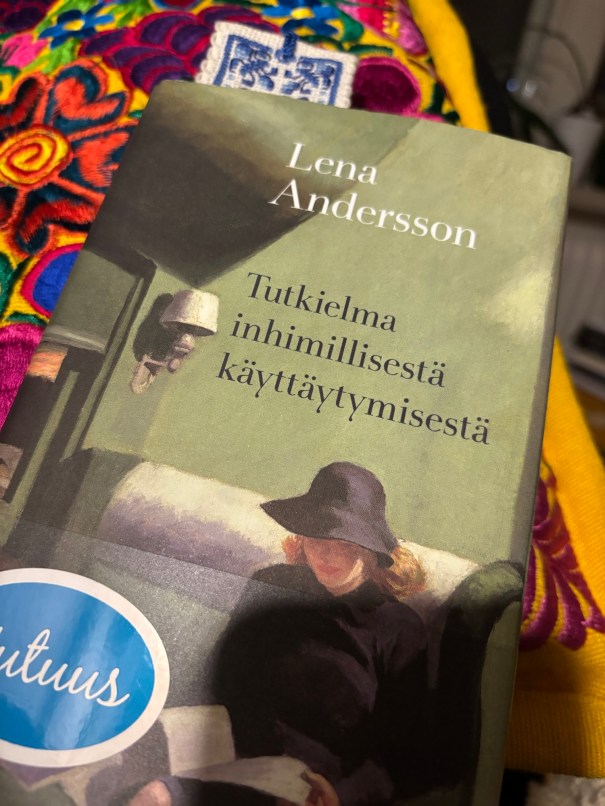
Why has it taken me this long to find Lena Andersson? The way she writes how people – especially women – behave, think and feel is extraordinary. I felt seen, and it was not comfortable. I think I know people like her characters, or at least I’ve met them, or at least that’s what they look like from outside… She shows the patterns people get into, in their own heads, and in relationships with others. It feels a bit like watching a fly trying to get out of a window, bashing against the pane, although it’s open and a few inches to the left is the fresh air. But do they want to change route?
I read Studie i mänskligt beteende in Sanna Manninen’s Finnish translation (she translates the cool stuff, well at least a lot of it, see On the Calculation of Volume).
Tutkielma inhimillisestä käyttäytymisestä sounds dry. That’s why I turned the title round in English to make it look like an academic thesis. But academic it isn’t; it feels very real. And I’m not the only one to think so. The August Prize, Sweden’s major literary award, gave it a nomination. And as I write, Siltala is releasing a new edition in Finnish tomorrow. And it’s in Danish and Norwegian at least. Why not in English, yet?
Because English publishers don’t take to short stories as they should. These ones are interwoven; minor figures in one are protagonists in another, and in a third, their friends talk about them. This novel-of-stories format is like turning a kaleidoscope. It works. And you can tell yourself, I’ll just read one. Until you’re into the next one, and the next…
I did some digging around so you don’t have to. Andersson’s Wilful Disregard won the August Prize in 2013, and Sarah Death translated it into English. Pan Macmillan also has her Acts of Infidelity. You can get a taste of them in Saskia Vogel’s translation at Granta. Here’s hoping that one of them will translate these short stories too. Pan Macmillan, what are you waiting for?

Translator, editor, writer, reader


 found in translation
Leave a comment