After tomorrow the days disappear

after-tomorrow-the-days-disappear

I finished this book of Persian poetry just in time for Nowruz, which is the Persian New Year. Starting the year at the spring equinox makes a lot of sense.

And starting it with 700-year-old-poems like this was a pleasure.

AfterTomorrowRubai5RebeccaGould

You might know Rumi or Hafez, but you’re less likely to have heard of this author. Hasan Sijzi (1253-c.1330), was actually from Delhi; but then, it was part of the Persian and eastern Islamic world, a “haven for wandering scholars and poets” fleeing Mongol invasions.

Hasan writes in the most elegant classical forms, ruba’i (quatrains, like the one above) and ghazals, which are infused with love and longing, something like a sonnet, with a repeated radif or refrain (like these two below).
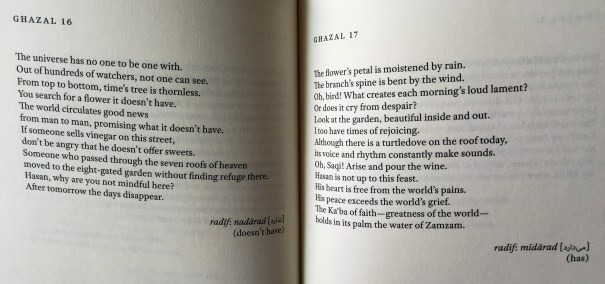
AfterTomorrowGhazal1617RebeccaGould

Translator Rebecca Gould faced a huge challenge to translate these into English. As she says in her introduction, English doesn’t have as many resonant end rhymes as the original Persian, making it difficult to repeat and vary the radif elegantly. Gould agrees with Walter Benjamin that translation is “a provisional way of coming to terms with the foreignness of language.” Her scholarly translation helps to breach that gap for us, setting each poem in context.

After Tomorrow the Days Disappear is out now from Northwestern University Press. Why not start the new year by discovering an ancient tradition?

Unknown's avatar

Translator, editor, writer, reader

Tagged with: , , , , , , , ,
Posted in books, poetry, translation

Leave a comment

advent Alice in Wonderland American And Other Stories Antonia Lloyd-Jones Arabic Argentina Beowulf Berlin Best Translated Book Award Bible books Brazil Brazilian Portuguese British British Library Buddhism Catalan Children's Books China Chinese Christmas Christmas Carols Contemporary Czesław Miłosz Danish Dari David Hackston Deep Vellum Dublin Literary Award English Estonian Fantasy Farsi Fiction Finland Finland 100 Finlandia Prize Finnish Fitzcarraldo Editions Flemish Free Word Centre French George Szirtes German Greek Hebrew Herbert Lomas Herta Müller history Hungarian Iceland Idioms Illustration India international International Translation Day Irish Gaelic Italian J. R. R. Tolkien Japanese Jenny Erpenbeck Johanna Sinisalo Korean Language language learning Languages Latin Literature Lola Rogers Lord of the Rings Mabinogion Man Booker International Prize Maori Maria Turtschaninoff Moomins New Year Nobel Prize Nobel Prize for Literature Norwegian Old English Olga Tokarczuk Owen Witesman Oxford English Dictionary Penguin PEN Translation Prize Persian Philip Boehm Phoneme Media Poetry Poetry Translation Centre Polish Portuguese Pushkin Press Queer Romanian Rosa Liksom Russian Salla Simukka Second World War Short Stories Sofi Oksanen Spanish Stanisław Barańczak Suomi100 Susan Bernofsky Svetlana Alexievich Swedish Switzerland Thomas Teal Tibetan Tove Jansson Translation translator Translators Without Borders Wales Warsaw Welsh Wisława Szymborska Witold Szabłowski Women in Translation Month words Words without Borders writing YA

Enter your email address to follow this blog and receive notifications of new posts by email.

Follow found in translation on WordPress.com
Archives