
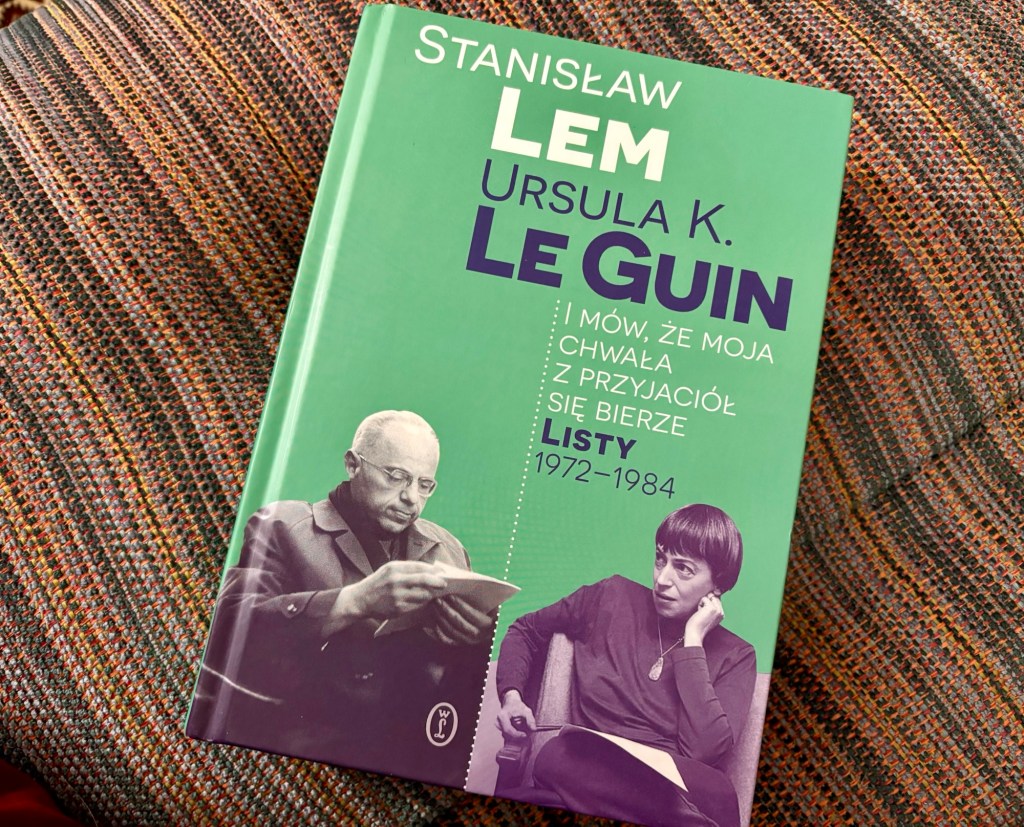
This one jumped out at me from the blue sky (dzięki Paweł!). I’ve read less Lem than le Guin, but the idea of them writing to each other was startling, pleasing. I ordered their 1972–1984 letters from Wydawnictwo Literackie straight away. The subtitle is something like “say that my praise comes from my friends.”* Lem and le Guin did indeed defend each other’s reputations. In the Cold War, it wasn’t easy to be an “Eastern bloc” writer in the West, or for a “Western” writer to get published in the East. They shared their problems with publishers, editors, and writers’ associations.
Stanisław Lem’s son, Tomasz, translated their correspondence from English into Polish. So the only parts of the book originally written in Polish are an introduction and an afterword. Agnieszka Gajewska, its editor, wrote the introduction to the book itself. Stanisław Lem wrote the afterword to Stanisław Barańczak’s Czarnoksiężnik z archipelagu (1983), the Polish translation of Ursula le Guin’s A Wizard of Earthsea (1968). Barańczak, a poet himself, also translated Szymborska into English with Claire Cavanagh, and Shakespeare into Polish. But in the early 1980s Wydawnictwo Literackie did not want to publish his translation as he was active in KOR, the Workers’ Defence Committee. In the end, they published Czarnoksiężnik z archipelagu in another series.
The book includes le Guin’s 2002 introduction to Irmtraud Zimmermann-Göllheim’s German translation of Lem’s Solaris (1961). Le Guin wrote that in English for translation into German, and here Tomasz Lem translated it into Polish. Joanna Kilmartin and Steve Cox had translated Solaris into English via French (1970), which Stanisław was never happy with. But Bill Johnston since translated Solaris directly (2011) and Tomasz and Lem’s wife, Barbara, preferred this version. Confused? Welcome to the world of translation rights, personalities, conflicts and convolutions.
What I enjoyed most about reading Lem and le Guin’s letters was being transported back in time. Even though their books transport you forward, into the future. But they were writing to each other from soon before I was born to when I began to read their work. Communication was slower, then. Some facsimiles of their original letters and photographs of them both are in the book. They never met in person – travel was harder, then, too. But they found a kindred spirit in each other, from their very different contexts. Reading about that was fascinating. I wonder if an English edition is in the works? Would you want to read it?
* As Pawel pointed out “And say my glory was I had such friends”, is a quote from a W.B. Yeats poem, translated from English in the first place. Thank you! Edited 31.1.

Translator, editor, writer, reader


 found in translation
Interesting; I’d never have thought it.