

An hour and a half of my life listening for every year she was in office. Yes, Angela Merkel’s Freiheit/Freedom clocks up an impressive 24 hours as an audio book, or 720 pages. I stuck with it, because I wanted to find out how it a team of translators could come up with the English on a very tight deadline. Three of the eight came to talk to the ITI GerNet book club to tell us how they did it.* It’s an impressive achievement.
Her childhood between East and West, her youth in the GDR, shaped her. Knowing about it made me appreciate her more. The most enjoyable sections, for me, were about those early years, from the 1950s to the 1990s, when she won Russian language competitions, did her PhD in quantum chemistry, and got into politics. I struggled somewhat to keep up with politicking around the financial crisis, for instance. But Merkel is nothing if not thorough in her record of her 16 years as Chancellor.
Our politics are different, but it was worth hearing her perspective. How much do we do that, anymore? Listen to people whose views differ from our own? Listening to Merkel, I found more common ground than I expected.
Shortly after we discussed the book, I saw a meme of Merkel saying something like “Gran Against the Right” (Oma Gegen Rechts). The Berlin left-wing paper, taz, was sharing Merkel’s criticism of her successor as leader of the conservative CDU, Merz. As leader of the opposition, Merz drew on AfD support to pass a resolution on border policy. To do this he broke a long-standing taboo in German politics against allying with the far right. Hundreds of thousands took to the streets in protest. AfD stands for Alternative for Germany. And the name came from something Merkel said, as chancellor. We have to welcome refugees, she said in 2015, because “there is no alternative.” AfD formed to say that there is. In their elections next weekend, the Germans will decide which alternative to take.
In her memoir, Merkel does not apologise for what she said or did, but she does explain.
She does not say she regrets much. But what she doesn’t say is as important as what she does. Merkel refused to be edited down. And she has a clear desire to set the record straight, for history. If you’re wondering how Germany, Europe, or the world got to where it is right now, it’s worth listening to what she has to say.
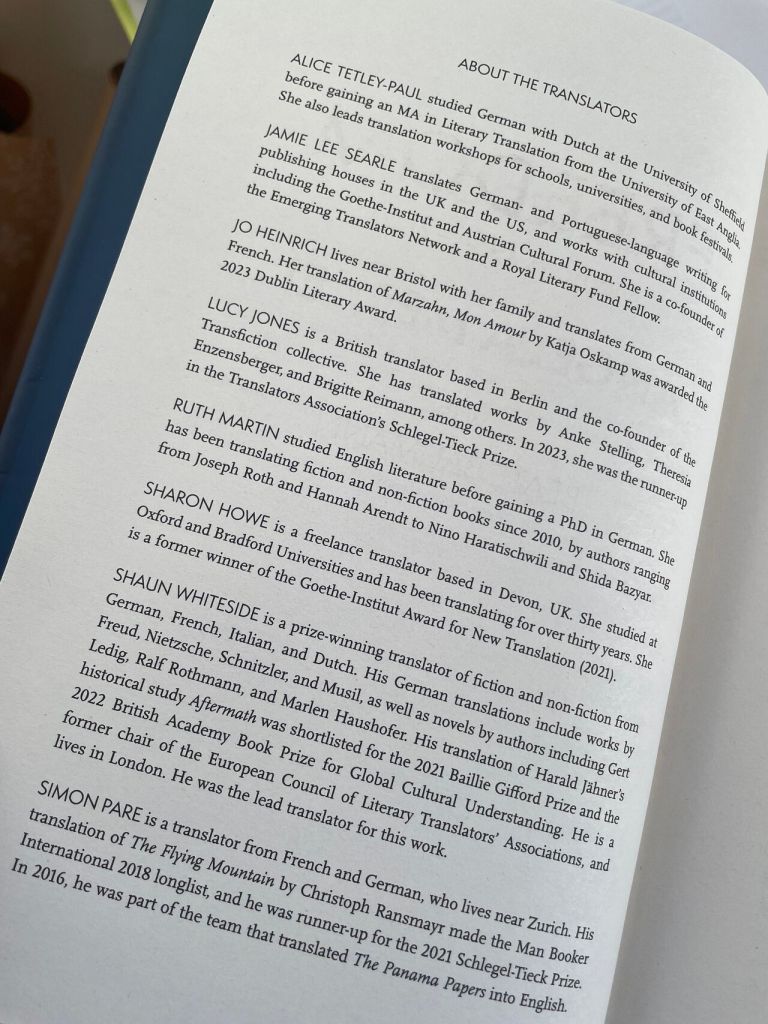
* Thank you to Jo Heinrich, Ruth Martin, and Jamie Lee Searle for coming. The other five were Alice Tetley-Paul, Lucy Jones, Sharon Howe, Simon Pare, and Sean Whiteside.

Translator, editor, writer, reader


 found in translation
Leave a comment