
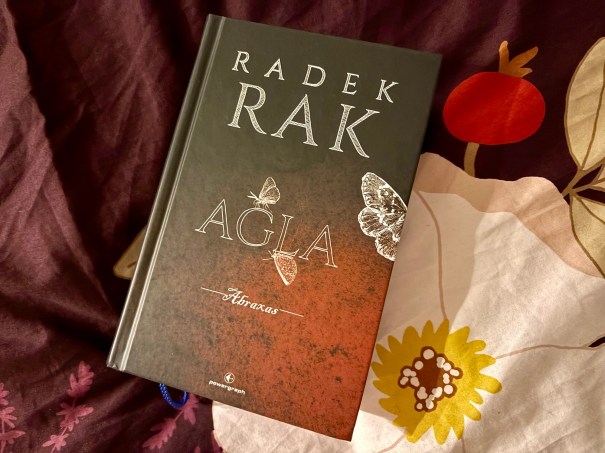
The Agla trilogy is over and I am feeling slightly bereft. I’d waited for a long stretch of holiday when there was nothing I HAD to read, for translating or editing, for book clubs, for work… I wanted to have fun, to dive into a world built over hundreds of pages with characters I’ve loved and hated for years. But I also didn’t want it to end. And volume three was the end.
Agla is set in somewhere like Poland, next to somewhere like Russia, with strong echoes of Kraków and Siberia. But the parallels aren’t direct, because magic twists the world in different directions. At the risk of sounding like a large digital platform, you might like it if you liked Philip Pullman’s Lyra trilogies, His Dark Materials and the Book of Dust. As in Pullman, in Rak the moral boundaries are not blurred, exactly, but characters are not caricatures of good and evil. They make bad choices, and in trying to backtrack, they often make things worse. They can’t always control the dark forces they unleash.
Radek Rak, a vet by background, is best known for Baśń o wężowym sercu. The “tale of the snake heart” won Poland’s major literary award, the Nike, in 2019. It has been adapted for theatre and as an opera. And it has been translated by most of his neighbours, into Czech, Hungarian, Russian and Ukrainian. His publisher, Powergraph, specialises in fantasy. And Rak’s writing is full of ancient Slavic mythology, magic and monstrous creatures. You’d have thought that “it’s better than that Witcher” would get you somewhere. But I suppose opera and computer games have different-sized audiences. It’s about time Rak got translated into a few more languages. And why not English, next?

Translator, editor, writer, reader


 found in translation
Leave a comment