
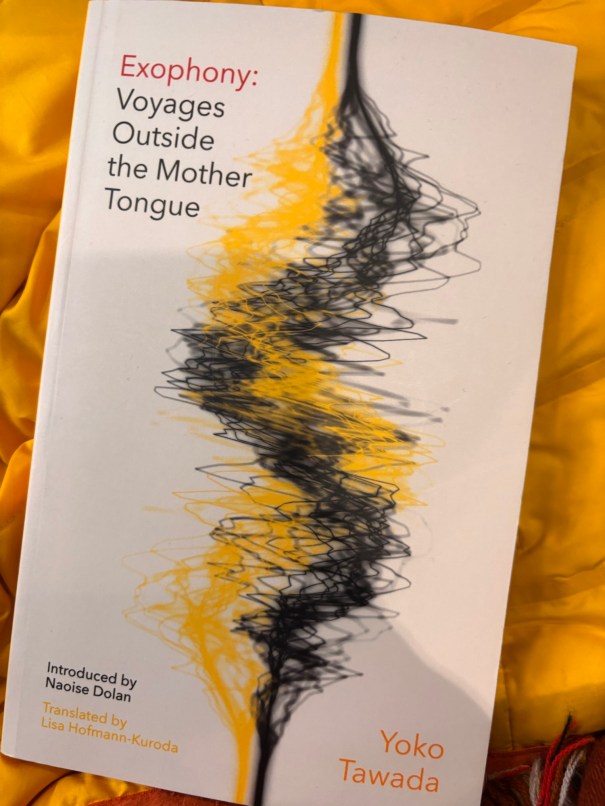
What does it feel like to be so far away from your own language that you can see it from the outside? What does dwelling in another language do to you, and to that language? What can you create in the space between? Towada asks all these questions and more, with some very interesting answers. She’s the only other person I’ve seen write about the space between languages as a good thing, a creative place you’d want to be. For her, it’s a ravine from which poetry can rise.
Yoko Towada’s “voyages outside the mother tongue” are translated by Lisa Hoffmann-Kuroda. Since Towada explained German terms to her readers in Japanese, Hoffmann-Kuroda explains Japanese terms to her readers in English. This double distancing could be unnerving, but it allows readers to make new connections. I was reminded of Maria’s Stepanova’s The Disappearing Act – she “disappears” into German, too, from Russian (I read it in Arja Pikkupeura’s Finnish translation, Kadoksiin). And of Alexandra Salmela, who was born in Bratislava and stretches Finnish in surprising directions.
In short pieces that you could read in any order, Towada “feels the linguistic texture” of different cities. In and between them, language is on the move, and, as she says in her preface, she is “swim-walking” in it, finding and making up new words as she goes. Is her voyage in a pirate ship, looking for buried treasure? She prefers to see herself as one of the fish.
Towada gets to know German from the inside over decades, in a way I recognise, though she’s lived there much longer than I did. But I’ve never felt quite so exophonic myself as the one and only time I was in Japan – being functionally illiterate. Yet Towada asks her students to go ahead and translate characters they can’t read. How does the shape resonate? What does it remind you of? Where will the story take you? Perhaps (as one of her chapters is titled) towards the horizon, where words dissolve…
Exophony was published by Dialogue Books last year, and in 2003 in Japan (so I could have read it when I went, except I couldn’t read it). Some books are worth a two-decade wait!

Translator, editor, writer, reader


Intriguing