
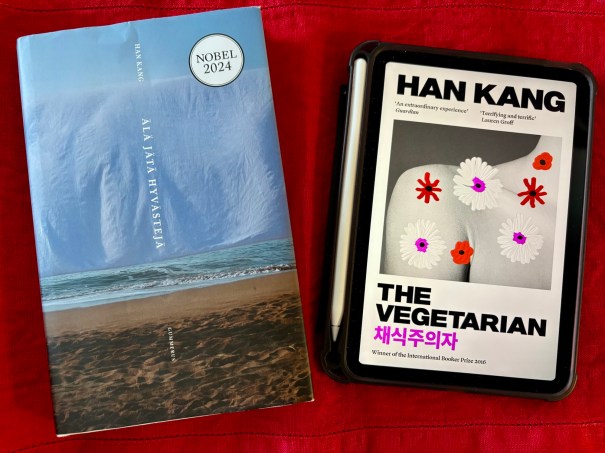
The journey from Korea to the northern fringes of Europe is a long one. To get there, you have to go on a TV show, or stir up a storm in a translators’ teacup. Or you could miss the bus, and walk through the snow.
Yes, I finally got round to reading Han Kang when she won the Nobel Prize in Literature. Not least because my local book club likes to read women Nobelists. But also because I knew we’d be reading a lot of translations – Finnish and English, French and Polish, and more. When you’re starting from Korean, even if all those languages are European, the results might be rather different.
I’d not read The Vegetarian when it came out, even though it won the Man Booker International Prize in 2016. But I couldn’t avoid the debate about Deborah Smith’s choices for the English translation. That storm in a translator’s teacup has sparked a research literature of its own. (Here’s Sun Kyoung Yoon’s Korean feminist take.) By the time I read that in English, I’d read Kang’s most recent book in Taru Salminen’s Finnish translation, Älä jätä hyvästejä.(In English, it’s called We Do Not Part, translated by Emily Yae Won, who also worked on Greek Lessons with Deborah Smith, and Paige Aniyah Morris.)
I was lucky enough to meet Salminen at a local book event. She said that she was offered her first translation because she was on a TV show about women who had moved to Korea. (In English, here’s more about Salminen’s TV stardom and beginnings in translation). Earlier of Finnish translations of Kang were by Sari Karhulahti, who has translated Ngozi Adichie and Hodgson Burnett. Karhulahti translated from the English translation. In less common language combinations, bridge translations might be the first way an author reaches a new audience.
But what about missing the bus and walking through the snow? Salminen said herself that it felt right to translate Älä jätä hyvästejä into Finnish, because it’s set in the snow. And I read it in the snow, on an island, where the buses also don’t run that often and if you miss one, you’re in for a long walk. Salminen’s Finnish brought me very close to Kang’s Korea.
Moving into English, to read The Vegetarian, I found a character getting the bus, but in rather warmer weather. As with Annie Ernaux two years ago, I was wondering if she would feel the same; could I find connections between Smith’s Kang and Salminen’s Kang? Well, I did. But I was so much more aware of the cultural context in which the translators were writing, that it was not as easy.
Women’s lives and histories of violence permeate both books. As do the unclear boundaries between waking and dreaming, being well and being ill, deciding for yourself and accepting the fates. But while the language felt immediate in both cases, it was immediate to different places. To where I used to live and to where I live now. Is that how a translation should be found?

Translator, editor, writer, reader


 found in translation
Leave a comment