
Gwerful Mechain was writing in the 1400s but I only discovered her in 2019, in Zoë Brigley Thompson’s glorious, full-on rendering of I’r Cedor for Modern Poetry in Translation. That poem opens this collection of half a millennium of Welsh Women’s Poetry, 1460–2001. What does I’r Cedor mean? Read on… I gave you the beginning so you will buy it and read the rest!
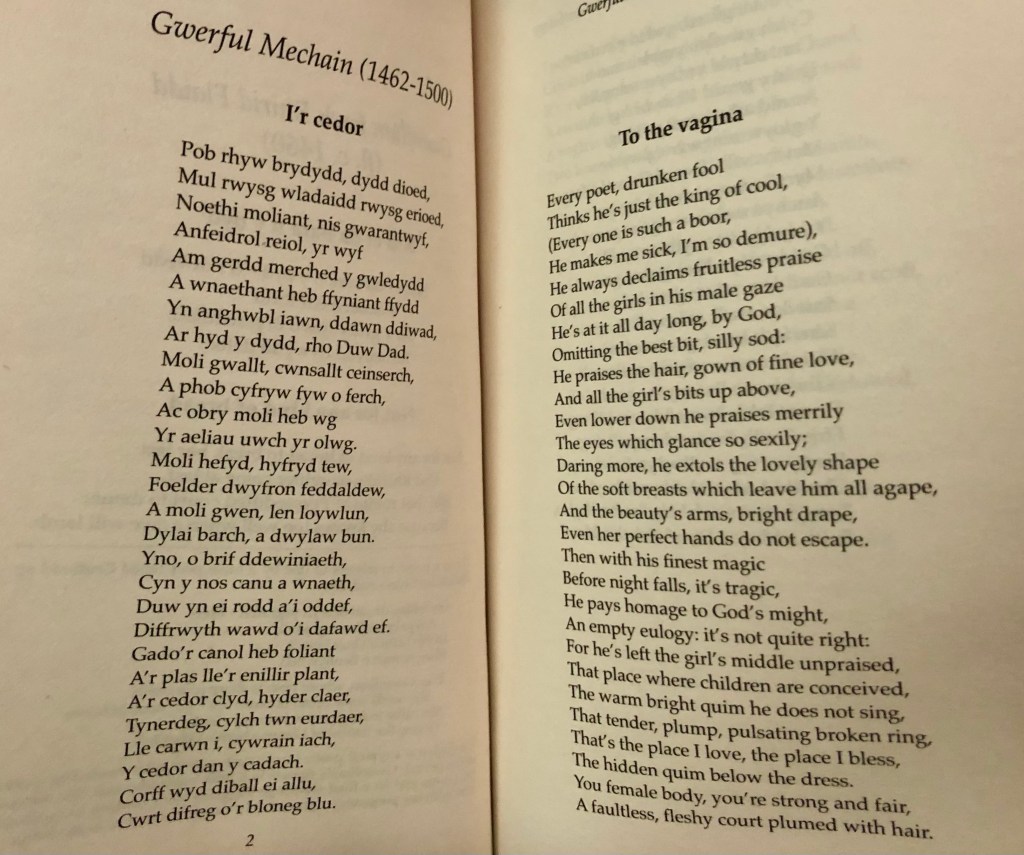
Katie Gramich (who also has a whole bookful of Gwerful) translated this and most of the Welsh poems here. She edited the whole volume with Catherine Brennan for Honno, the Welsh Women’s Press. Thank you Foyles for putting it in my path in the poetry section. This is a wonderful read for anyone with any connection to Wales or interest in women’s lives and writing. I read it from cover to cover in order, but I know I will dip back into it again and again.
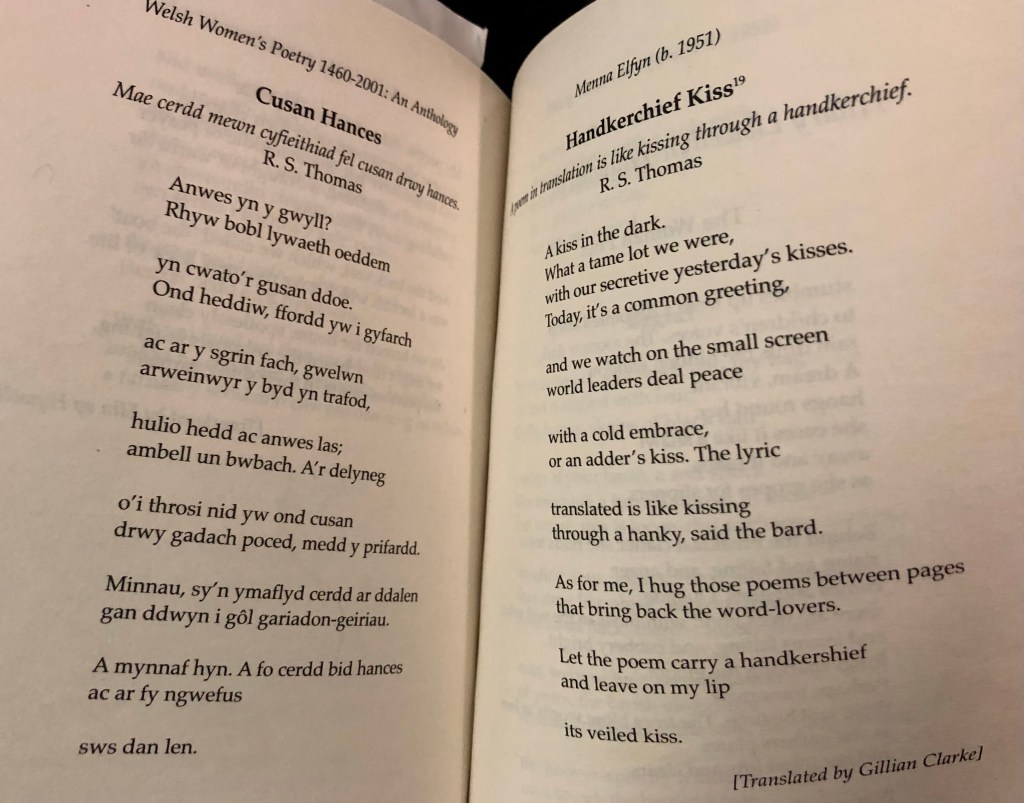
The greats are here, of course. A tribute to R S Thomas by Menna Effyn translated by Gillian Clarke combines a Holy Trinity of Welsh poets. And like Gwerful Mechain and the others before her, Menna Elfyn writes back to the male poet with great wit:
Yet the pages brim with new discoveries. How did I get through an entire Cardiff school system without meeting these women? This book is a springboard for reading them more. One I want to follow up on is Maria James. She left Wales aged ten and learned English on the boat to the US, where she worked as a servant. And wrote in English, but she misses Welsh, and Wales:

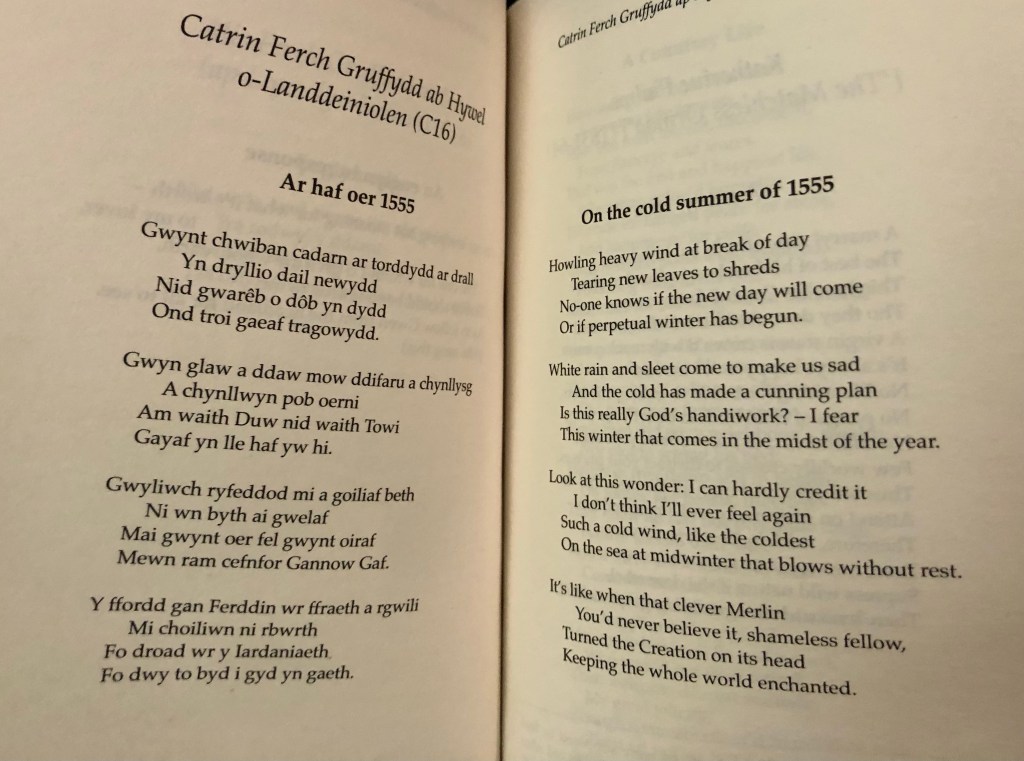
These women remember the old stories of the Mabinogion. Branwen, at least three Blodeuwedds, and Merlin:
The collection wouldn’t be complete without a was-she-wasn’t-she lesbian (Katherine Philips, the Matchless Orinda, 1631–64), a feminist rallying cry,

and a casting-out:

Of all the new and old forms used here, cynghanedd is fiendish to write, let alone try to echo in translation. So one joy of this book is that you can feel the rhythm and sounds of the Welsh, even if you can’t understand it (at) all. I learned a few new words just from one reading across the pages. As the introduction notes, even the poets in English wrote in forms that warm to reading aloud, or singing. Six poems here, or the beginnings of them, is a lot to share, but this book needs to be shared, and read. Maybe having it on the syllabus in my Cardiff schools would have killed it for me. But these women’s voices need to be heard in Wales and far beyond.

Translator, editor, writer, reader


 found in translation
Looks great.
My only quibble is the translation of Gwerfyl Mechain is so… tuneless? Sure there’s a better translation than that one.
I did prefer one I found her through in MPT that I mentioned actually!
Perhaps I should qualify that and write ‘a translation with more available access’. My subscription to MPT has run out.
We both need to do some digging… and I think I need to renew my MPT too!